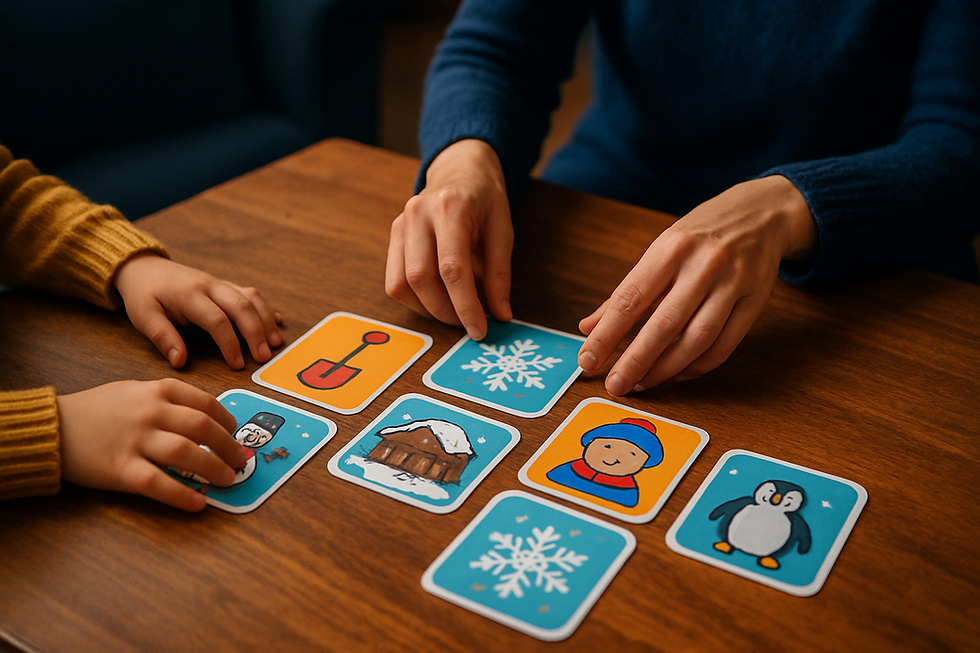
Fun Indoor Activities to Practice Speech and Language Skills in Winter

Updated: Aug 25

Is it a chilly January where you are? Is there snow on the ground and have the leaves fallen off the trees? If the answer to these questions is yes, then it’s officially the time to move play inside and find fun ways to keep the kids busy and entertained in the living room. While you do that, you can encourage your child's speech and language development with these indoor activities.
Who Doesn't Love an Obstacle Course
Use the couch cushions to make a tunnel, and blankets and pillows can be a path from one room to another. Hide items inside the tunnels, put a treat into a plastic Tupperware container and get the kids moving!
How to Target Speech or Language Goals?
Give verbal directions that are as complex as your child understands: Hop on the blanket like a bunny, slither like a snake through the tunnel.
Give clues for hidden items to target sounds: I'm thinking of something that we drive and makes a vroom sound (/k/ sound for "car"); Where is the animal that makes a "woof woof" sound (/d/ sound for "dog")
Find the hidden treats and ask for help: did you put a cookie in a closed and see through container, have your toddler who is working on single words find it and ask for help such as: "open" or "help." Kids working on 2 words can say: "open please" or "mommy help."
Get winter speech therapy practice ideas
Play Simon (or Daddy) Says
This is a classic that has been around forever since we all like to give directions! Here is how you can target different language goals:
Give 1 or 2-step directions: touch your nose; or touch your nose then jump up and down. You can make these as complex as you like. For example: touch your nose after you jump two times up and down. The addition of the words "after" and "two times" makes it harder for kids to work on more complex comprehension skills.
Target vocabulary: have your child touch their nose, cheeks, and knees. You can also target other object vocabularies you have around them like having them touch or grab a ball or shoe. This can be made complex as well by giving clues: touch the thing we put on our feet before we go outside, or touch the green jacket not the red one.
Make Something to Eat
Is it snack time? Making a meal or a snack is a great opportunity to listen to and use language. You can also practice sharing the finished meal with loved ones. Here is one snack easy enough for the little ones to make with minimal help. You can target:
Describing: What do the ingredients feel/look/smell/taste like? Fuzzy kiwis, round apples, smelly broccoli and sour lemons. There are so many ways to talk about the food we eat. This is a great way to expand vocabulary.
Taking Turns: Is your child practicing taking turns? You can say "my turn" and "your turn" while pointing to you or your child. And take turns adding ingredients to the bowl or taking bites from the snack you made.
Asking for More: Is your toddler working on saying "more?" You can put the snack just out of reach and have your child sign/grunt/point/ask for "more" depending on their level of language skills.
You can tweak these activities to target any speech or language goal. Just ask your online speech therapist to modify the suggestions we have here. Our Better Speech SLPs are always giving clients homework to work on their goals and showing them how to practice with these types of activities.
At Better Speech, we offer online speech therapy services convenient for you and tailored to your child's individual needs. Our services are affordable and effective - get Better Speech now.


Frequently Asked Questions
How much time should we spend on speech practice activities each day?
Even 10 to 15 minutes of focused, playful practice daily can make a real difference for most children. Consistency matters more than duration, so short sessions spread throughout the day work just as well as one longer block. Follow your child's energy and keep things fun so they stay engaged and willing to participate.
Can board games and card games really help with speech and language development?
Absolutely. Games naturally encourage turn-taking, listening, describing, and storytelling, all of which are core language skills. Games like Guess Who, Headbanz, or simple Go Fish prompt kids to ask questions, form sentences, and use new vocabulary. The social context of a game also makes practice feel rewarding rather than like work.
What indoor activities work best for toddlers who are just starting to talk?
Simple activities like reading picture books together, singing nursery rhymes, and narrating everyday routines like cooking or tidying up are excellent for toddlers. Pointing to objects and labeling them clearly gives little ones the building blocks they need. Play-based activities such as building blocks or toy kitchens also spark natural back-and-forth conversation opportunities.
How do I know if my child needs professional speech therapy rather than just more home practice?
If your child is significantly behind typical milestones, is hard to understand by familiar adults, or shows frustration when trying to communicate, it is a good idea to consult a licensed speech-language pathologist. Better Speech connects families with licensed, insurance-ready therapists online with no waitlists, so you can get a professional opinion quickly and start support without delay.
Are there specific winter-themed activities that can make speech practice feel more seasonal and exciting?
Yes, tying practice to the season keeps things fresh and motivating. Try storytelling prompts about snowstorms, describing pictures of winter scenes in detail, or playing hot cocoa pretend-play scenarios that build vocabulary. Reading winter holiday books and acting out the stories also encourages expressive language, sequencing, and imagination in a cozy, low-pressure setting.
About the Author

Aycen Zambuto
I’m a seasoned educator in speech therapy with over six years of experience helping people navigate challenges in communication. Throughout this time, I’ve found joy in guiding individuals through a variety of therapeutic journeys, from toddlers with apraxia to seniors with dysphonia.
I’m passionate about demystifying this complex world of speech therapy and helping readers around the globe achieve clear and effective communication. When I’m not writing about speech, you’ll often find me reading, traveling or spending time with friends and family.